
Glenfiddich 1955
Private Vintage
Cask, 4221 Bottle 168
Aug 16 2006
Speyside Single Malt Whisky
52.6 % abv
£5000
Water. I wrote a bit about it on my last post, and will do so again today. Or, will at least make a few citations organised in a pretty haphazard way.
Whatever the effect of water on whisky, it is fair to say that the single most important fact in choosing the location of distillery is the availability of a good clean water source as water is used in nearly every stage of the whisky-making process. Out of necessity, crofter distilling took root along the arteries of the land, "lands of hills and valleys, of lochs and mountain streams, of much poor land but of very good water," (R.J.S. McDowall, The Whiskies of Scotland, 1967). Today, most distilleries use surface water, "collected from a loch or resevoir above the site, and usually it is soft water. Much of this water is coloured brown by peat. Often different sources are used for the production and colling processes. This is very important condition to build the distillery near a good source of water supply. The quality of the water is the keystone of making good whisky." (Misako Udo, The Scottish Whisky Distilleries, 2006).
Understood, but "quality" of the water? What the hell does that mean? No poisons, fertilizers, etc., okay. But beyond that? "The water source, whether it is alkaline or acid, hard or soft, plays an important part in the taste and smell of the final single malt." (Helen Arthur, Whisky: The Water of Life=Uisge Beatha, 2000)
The mineral content affects the taste and smell?
"Production water used in the production of wort makes a major contribution to the quality of the spirit that is produced." (Timothy C.S. Dolan, Whisky Technology, Production & Marketing, 2003).
Quality of the spirit? What does that mean? What is water's effect on the character of the spirit?
"Douglas Murray of Diageo [...] sums up the general industry view. 'On a scale of one to one hundred, I would rate it at between one and two." (Andrew Jefford, Peat Smoke and Spirit, 2004)
Taken with a grain of salt, certainly, but is there any truth to it?
"Douglas Murray of Diageo [...] sums up the general industry view. 'On a scale of one to one hundred, I would rate it at between one and two." (Andrew Jefford, Peat Smoke and Spirit, 2004)
Taken with a grain of salt, certainly, but is there any truth to it?
A representative from the Scotch Whisky Research Institute (SWRI) told me that while it was important to have untainted water at all stages of the production process, "with mashing there is the additional possibility that the composition of the water used can have an impact on the progress of fermentation. Research carried out at SWRI by one of our PhD students showed that using mashing waters from different sources, with different compositions, can influence flavour." So this answers my main question, "Can water used in production effect the flavour of whisky?" But, as the representative from Diageo queried above, how much of an effect does it have? "Obviously the use of tainted water can potentially have a huge negative impact of the flavour, depending on the degree and nature of the taint. The influence of different mashing waters on flavour is detectable, but it is important to be aware that these differences are subtle. However, many other factors in whisky production, when looked at in isolation, only have a subtle effect. It is often the accumulation of a large number of subtle difference that give the overall larger differences in final flavour."
It would seem, in spite of my intial doubt, that water does play an important part. Yes, it is only one variable of many (and a small one at that) that affect the nature of a given whisky, but its importance is accounted for by science. But it's not as if we needed that, is it? We already know it is accounted for in our romantic imaginations, reinforced by the whisky maker's themselves (Ardbeg named Uigeadail, it's cask strength no-age statement 2003 release, after the loch that supplies its water; Dalmore's precious 62yo sold at McTear's in 2002 was christened "Kildermorie" after the distillery water source, William Grant & Sons had a blend called Robbie Dhu, etc., etc...)
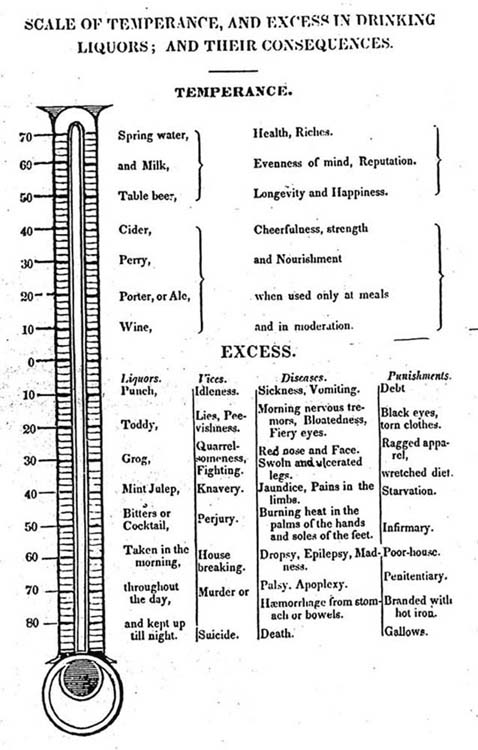
"Water, taken in moderation, cannot hurt anybody." - Mark Twain. Well, Benjamin Rush had other ideas, as exhibited on his Scale of Temperance. Rush's moral thermometer (1828) varied slightly, but in every incarnation, spring water was the drink of the highest order leading to health, wealth, serenity of mind, long life, etc.
"Water, taken in moderation, cannot hurt anybody." - Mark Twain. Well, Benjamin Rush had other ideas, as exhibited on his Scale of Temperance. Rush's moral thermometer (1828) varied slightly, but in every incarnation, spring water was the drink of the highest order leading to health, wealth, serenity of mind, long life, etc.
Water, that mix of hydrogen and oxygen, is vital for all life, for all living spirits, and vital for making whisky. "Personally, however, I prefer [...] the enduring mystique - whisky-making as something akin to alchemy." - Gavin D. Smith 

TASTING NOTES:
Fresh and fruity with peaches and pears, but weighted by cream, oak, and evident time.
A savoury, appetizing, tapas-like array of flavours: parsley, brie, pastry, sage, lamb, stewed apples, all drying into a finish of yellow plums, hard peaches, and carpentry.
SUMMARY:
Wholly unique. Unusual, rich, and deeply interesting, a dram to cotemplate and revisit. An expensive luxury, no doubt, but nonetheless, too bad it is all gone.
Malt Mission #381
SUMMARY:
Wholly unique. Unusual, rich, and deeply interesting, a dram to cotemplate and revisit. An expensive luxury, no doubt, but nonetheless, too bad it is all gone.
Malt Mission #381


