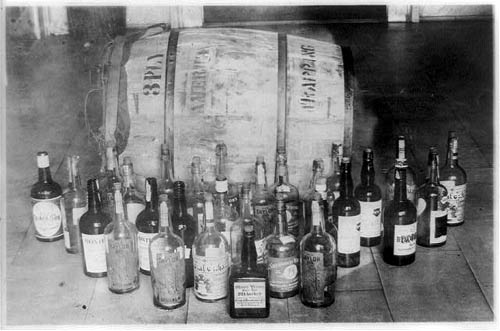
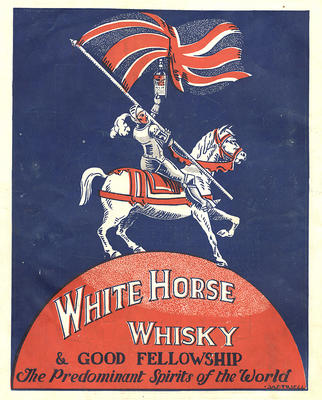
Some people have noted that we have a lot of blends on our shelf. Well, thanks for reading, and you are right. Many have asked "why all the blends?", "Who cares about them?" Well, I do. And maybe you should. They taste good, have left an often hilarious trail of adverts over the years, and are cheap. If that's not enough, the history of blended scotch whisky is really the history of the whisky industry as a whole. So, I am going to take the time and do my best to tell that story. Over the next few weekends I will cover history, current status and trends, and ultimately, the future.
Many of us take the current climate of whisky industry for granted. Single Malt Scotch Whisky is a worldwide phenomenon today, but it has not always been that way. Blended whisky, which makes up 90% of total worldwide Scotch whisky sales, has helped make the 'single malt revival' possible. And while blends sales are about 25% less today than they were in 1980, it is the history of blended whisky that tells the story of whisky’s international popularity, of why more than 10 bottles of Scottish whisky are sold every second.
So, why do blends sell better than singles?
We all have this idea that blends are ‘blands’, made on the cheap

 with cheap ingredients for cheap tastes. This is not (necessarily) the case. The pure ambition of blending is to create whisky that is more than the sum of its parts producing a distinct, dense and satisfying dram suited to many different moods and tastes. This is why blending is often called an art, why every blending family or house or whatever has a 'style', and why every blender has their own analogy or metaphor to describe their product, their craft, and their art.
Colin Scott of Chivas Brothers says that making their blend "is like building a house; with malts as the bricks, grains as the mortar and Strathisla as the foundation. Chivas Regal is one shape of house, 18-year-old is grander and Oldest is a castle!" Robert Hicks of Ballantine's and Teacher's blends subscribes to the more musical analogies (clichés circulate that single malts are soloists and blends are the orchestra), saying "You can play as many tunes with grains as you can with the malts." Turnbull Hutton who has had his hand in all of the biggest of Diageo's current blends(Johnnie Walker, J&B, Bell's) echoes this sentiment, saying that in blending, "there's a lot of tunes you can play." And John Ramsay of Edrington(Famous Grouse) is quoted in 2000: "It's like putting together a good soccer team. you need a strong central core, then you can tack the stars around that." He goes on to say that, "a blend is a bit like a pasta with sauce. The grain is the pasta, edible, but bland, and the malts are the sauce, a bit strong on their own, but together, they're a great combination." This last one resonates with me. Like Kristin says when I ask her what she wants for dinner, "I can always eat spaghetti bolognese."

Single malt whisky is very rich, strong, holds distinct and often powerful characteristics, and the taste of it is rather different from one distillery to the next, and can even be from year to year. In recent years, growing numbers of people have become fascinated with exploring the variety of separate and individual flavours single malts provide for these very reasons. But it is also for these reasons that the selling of whisky was very limited for a long time. 150 years ago, people outside Scotland were not really interested in these strong, distinctive, and varying tastes. Irish whisky was the thing, and Scots took, and still do take, great pride in the 'strength' of their spirit; "It's not for everyone, thank the Lord." The main reason why Irish whisky is seen as 'smoother' is due to ingredients and chemistry: Unlike single malt Scottish whisky, most Irish whisky is not made from barley alone, and Scottish single malt whisky is always made in copper pot stills with the wash being distilled twice(usually). Irish whisky is (again, usually) distilled three times, and that produces a 'lighter' spirit that is higher in alcohol, and the higher the alcohol, the fewer the congeners, and congeners give us flavours.
In the 1820s a new form of still was invented by Robert Stein(John Haig’s cousin), a continuous still, which produced spirit in a continuous stream as long as wine, beer or some such mildly alcoholic wash was fed into it. A Dublin Excise officer, Aeneas Coffey, attended a demonstration of the new still, took the idea and developed it further, and it was Coffey's version of the continuous still that eventually caught on around the spirit producing world. It was first put into commercial production at John Haig’s Cameron Bridge distillery in Fife. The distillation method produced grain whisky using some malted barley but mainly maize and wheat, creating a different, less intense spirit than the malt whisky produced in copper pot stills. This invention was first exploited by Andrew Usher & Co who, in 1853, blended malt and grain whisky together for the first time to produce a lighter flavoured wh
 isky - extending the appeal of Scotch Whisky to a wider market.
Many blends started in the shops of family grocers. Others began at the hands of enterprising wine merchants. Glass bottles were taxed and therefore expensive, so merchants were not branding by the mid 19th century. Instead, customers would use their own bottles or receptacles or even buy their own small casks or whisky jars called pigs, and fill them up with what the grocer had in stock. In this era, consistency and quality control was in the hands of the retailers and there were many reports of bulking up goods with flour, with bone dust or dried mashed potatoes, tea with dried tree leaves, and whisky with sherry, glycerine or green teas.
The Spirit Act of 1860 made it possible to produce large volumes of blended whisky in bonded warehouese, ie. without having to pay duty. Many spirits merchants and grocers began to specialise in producing blends with the aim of having a very broad appeal, drinks which had a lighter character than malt whisky, but were more substantial than grain whisky.
Creating a flavoursome drink out of grain whisky yielded many economic advantages, none of which were missed by the many merchants who took up blending.
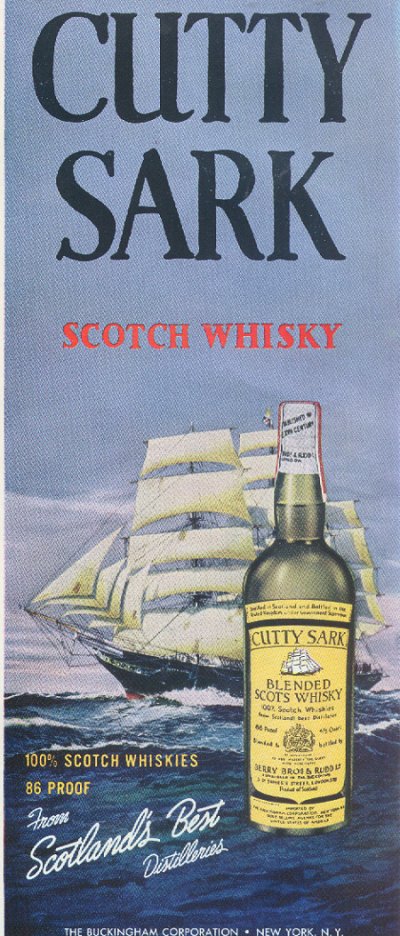 Since they were now able to achieve greater consistency of flavour by mixing these products, it also became desirable long term to brand their creations and promote them.
 Members of certain blending families, like Alexander Walker and Tommy Dewar, promoted their businesses by travelling extensively and securing contracts for their products in England and abroad.
Whisky was slowly taking the place of Brandy and Cognac in the snifters of the middle and upper classes in England and abroad, but it still had a reputation of being a rough drink, hot and fiery, for savage higlanders and was therefore not easily seen as something suitable for clubs and salons of the south. This is where the branding and marketing genius behind the early blenders came into play addressing the two big obstacles of acceptability and respectability.
It was an open air drink, fine when fishing on the river or hunting grouse, but not proper enough for the evening affairs of elite Londoners.
This is why it was important for names like Walker's, Dewar’s, Teacher’s, etc. to earn a currency of respect because over time this branding would guarantee accountability on consistency of each bottle which is what the desired market demanded.
Between the late 1870s and the turn of the century a handful of innovative and vigorous Scots promoted their new blended whiskies, first in London and then
 around the world to great success.
They were assisted by a number of factors. First was the appeal of the product, I mean, whisky tastes goooood. Second was the growing fashion for all things Scottish, led by Queen Vicloria herself. Third, well established rail and sea routes which made transportation far easier than it was previously. Fourth was by the existence of the British Empire, the biggest free market in the world. Fifth, and most significantly was a bug, Vastetrix, which devastated the vineyards of France between the mid-1860s and the late 1880s.
By 1865, phylloxera had spread to vines in Provence. Over the next 20 years, it inhabited and decimated nearly 70% of the vineyards of Europe. Many methods were attempted to eradicate phylloxera: flooding, where possible, and injecting the soil with carbon bisulfide, had some success in checking the louse, but were costly and the pests came back as soon as the treatments stopped.

Production of Cognac virtually ceased. Brandy became almost unavailable. And brandy (with soda) was the drink of the English middle classes.
Blended whisky (and soda) was there to replace it.

[Sources: many human beings (within and without the whisky industry), a few websites(many great whisky nerds have graced this e-world with their knowlege before me. Slainte and thanks), and serveral books: Jim Murray's 'Classic Blended Scotch', Dave Broom's 'Handbook of Whisky', Helen Arthur's 'Whisky', John Hughes' 'Scotland's Malt Whisky Distilleries', ALL of Charlie Maclean's work, and the Malt Whisky Yearbook 2006 and 2007]
more soon...
Bullocks to Blends? (Part Two)
Malt Mission HOME